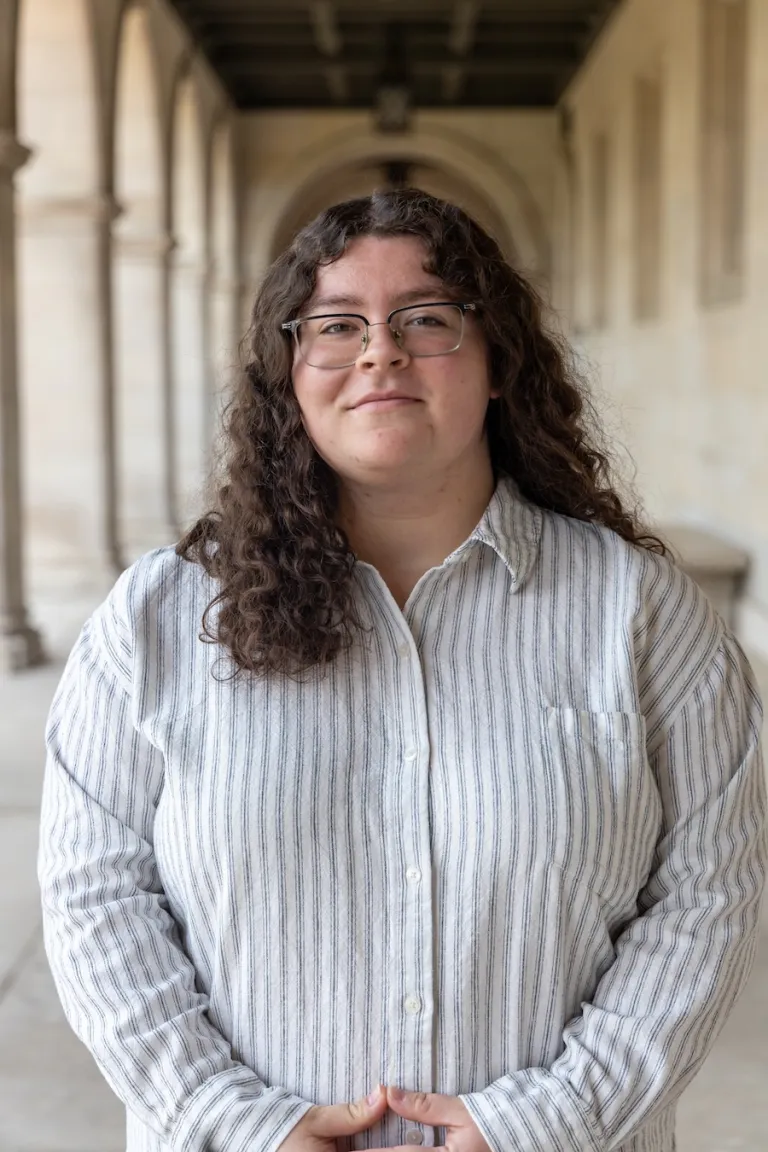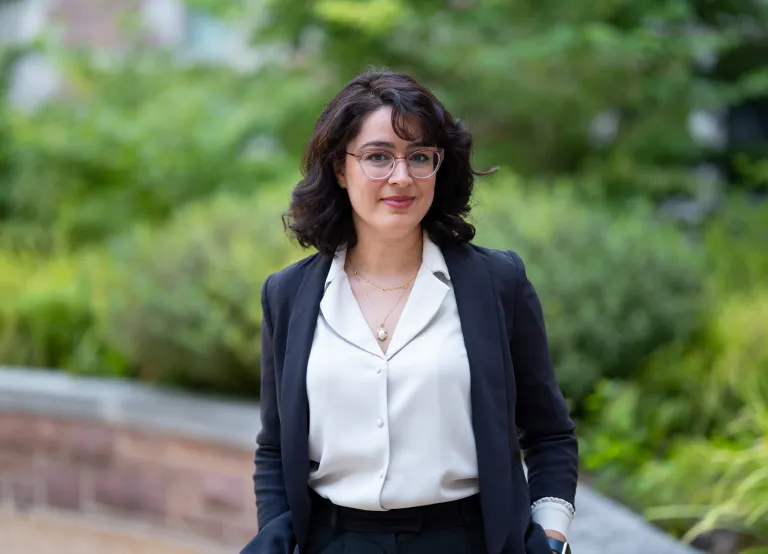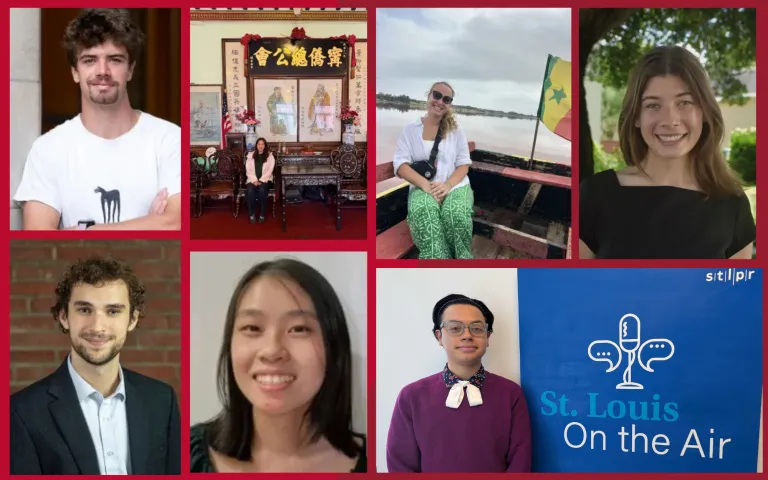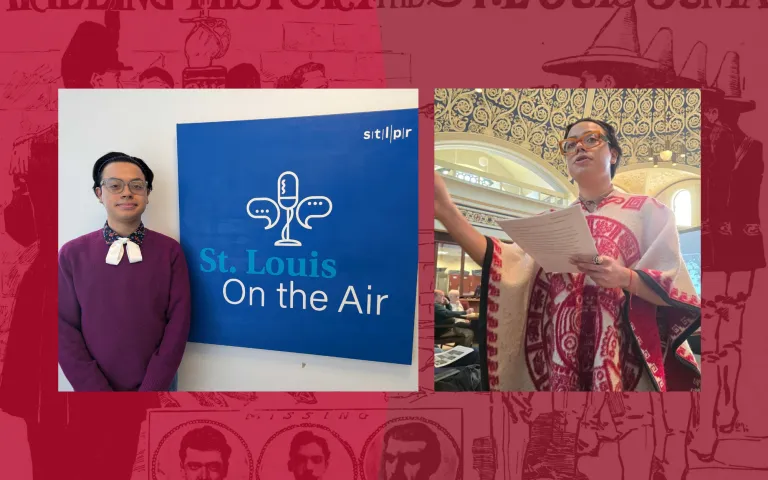
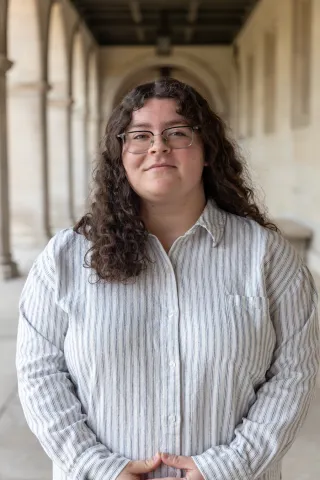
Mj Jones (BA History, ’26) won the undergraduate award for her senior honors thesis, “Mapping a World’s Fair: A Comparative Analysis of Native American Experience at the Louisiana Purchase Exposition.” Jones’ thesis examines the experiences of Native Americans at the 1904 World’s Fair by researching multiple locations and how they were participants, performers, and visitors in those sites. Using material from the St. Louis 1904 World’s Fair Collection, she analyzed photographs, maps, and other primary sources to explore this underrepresented aspect of the World’s Fair. MJ Jones participated in the Living History Scholars Initiative in the Department of History, and credits her success to the support she received when developing this research.
Want to learn more about the Living History Scholars Initiative?
Join us for an online Q&A Session on Thursday, October 29, 2026, from 5:30pm - 6:30pm (on Zoom) - students from all majors are welcome!
Learn about Living History Scholars
MJ Jones on what the award means for her -
It means a lot to me that my research has been recognized with Olin Library’s Mendel Sato Award. My thesis is now hosted on the library’s website and is searchable on Google Scholar, which I hope will make it more accessible. While researching and drafting my thesis, I read several other undergraduate works on Indigenous people’s experiences at the 1904 World’s Fair, which then shaped the direction of my thesis. I am indebted to the work of the scholars who came before me, and I am glad that my thesis will now be searchable and useful to anyone after me who researches the history of Native American people’s participation at the 1904 World’s Fair. Also, I would be remiss if I did not mention how happy I am to win this award with a thesis that I wrote for my history degree. I have been supported and mentored by countless members of the history department.
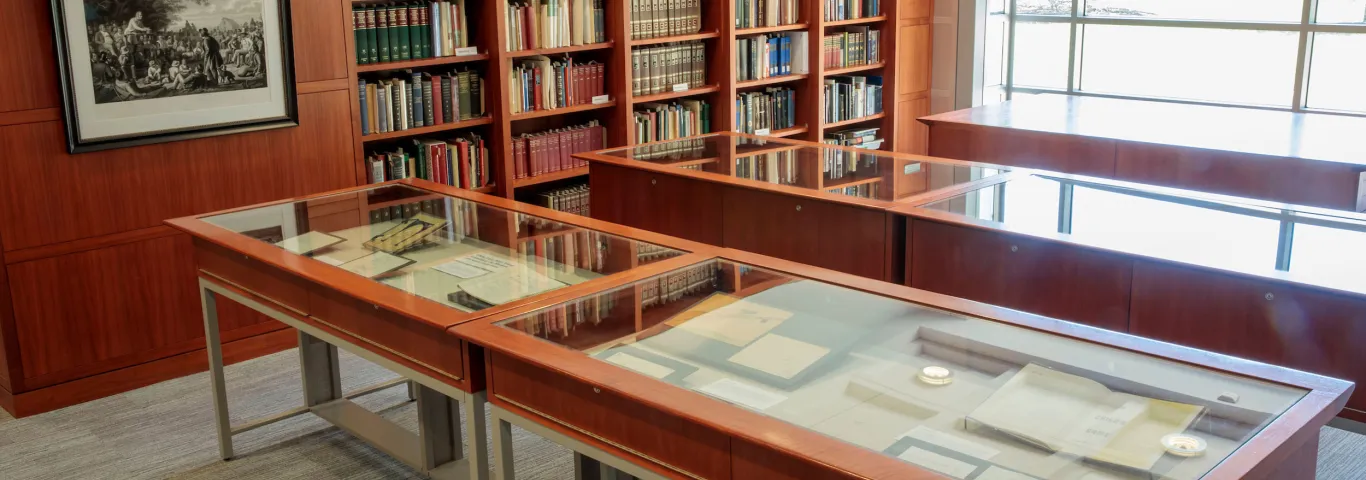
I learned about the Mendel Sato Award while I was researching in Olin Library. In early fall of 2025, when I began working with materials from the library’s Special Collections, I saw a flyer inside the research room that suggested that anyone doing primary source work should apply. I am fortunate that the library works hard to inform people about the award, since I did not seek it out. Once I finished my thesis in the spring, I spoke to my thesis cohort advisor, Dr. Watt, and my primary thesis advisor, Dr. Wakeley-Smith, both of whom agreed that it made sense for me to apply for the Mendel Sato Award. The last step before submitting for the award was to write a reflection. I submitted a short essay on how I used sources held in the library’s 1904 World’s Fair collection to better understand the physical space of the World’s Fair, as well as how Indigenous people were able to engage it strategically.
I am interested in the intersection of 1904 World’s Fair and Native American history since I find it important to understand the opportunities and limitations of the fair as a space of vast international interaction and presentation. While I have enjoyed learning about the World’s Fair, I am looking forward to entering law school in the fall, where I am sure that I will learn about new topics that interest me.
Jones' research process -
To construct my thesis, I examined a variety of sources from several archives that offered different perspectives on the experiences of people who attended the 1904 World’s Fair. At the Library of Congress and Yale’s Beinecke Library, I read the personal files of several key figures in the Fair’s Anthropology Department, the bureaucratic agency that hosted the majority of Indigenous people at the World’s Fair. This task was difficult, since I had to contend with the prejudices of figures who often did not spare much thought as to how the Indigenous people they invited to St. Louis would navigate the fair. I had to read these sources critically, since they did provide insight into the colonial messages that the fair was organized to impart. I also worked with many visual sources, such as maps and photographs, which I found in the Missouri Historical Society’s Research Library and Olin Library’s 1904 World’s Fair collection. When it came to visual sources, I focused on the expressions and emotions of the subjects captured rather than their clothing or any physical objects they held. I often did not know the circumstances in which the photos were taken, nor did I know who was behind the camera. The most useful information the photos gave me was about the emotions that the subjects could have felt, as displayed on their faces.
How did MJ Jones select this topic?
Although I did not start writing my thesis until the fall of my senior year, I began researching Indigenous people’s experiences at the Louisiana Purchase Exposition the fall of my junior year. I took a class about the Indigenous history of St. Louis, taught by Dr. Balraj Gill, and for the final I wrote about a women's basketball team from a residential school in Montana that performed at the 1904 World’s Fair. As I was working on my final, I realized that I did not want to stop researching the basketball team. I applied for and received funding from the history department’s Living History Scholars grant, which gave me the resources to interview descendants of the Fort Shaw basketball team and produce a documentary about their time at the World’s Fair. I presented my research and premiered a clip of my documentary at the history department’s “We’re Making History” end of the year event, which was a wonderful experience and the first time I had ever presented research in front of an audience. Even after learning about the 1904 World’s Fair for the entirety of my junior year, I did not want my research to end. I decided to expand my work into a senior thesis in the history department. After meeting with my thesis advisor, Dr. Wakeley-Smith, as well as speaking with Dr. Gill, I decided to focus on and compare three different locations that Indigenous people navigated at the World’s Fair. I spent the summer doing background reading and contacting archives that held sources relevant to my thesis, and the rest is history!
... the scholarship I produced within WashU’s history department... is being recognized by the broader community.
Producing my thesis and winning the Mendel Sato Award has been an honor and has changed how I think about my work. I appreciate the simple fact that the scholarship I produced within WashU’s history department with the oversight and assistance of history faculty is being recognized by the broader community. I am proud of the research I produced and I am happy that it is being recognized. More significantly, however, this award has given me hope that my research will assist future scholars interested in Indigenous experience at the 1904 World’s Fair. My own work was aided by the work of other researchers, at both the undergraduate and graduate level, who came before me.
MJ Jones double-majored in History and WGSS, and also received a minor in American Studies, concentrating in Native American and Indigenous Studies.
When people asked me for my major, the quicker explanation I gave was that I was a history major. Over a third of the classes I took at WashU were housed within the history department. I love history as a discipline, as it asks you to empathize with subjects from a variety of backgrounds and historical periods. The most meaningful classes I took encouraged me to consider the perspectives of women accused of witchcraft in early modern England or crusaders in the thirteenth-century; these courses taught me how to be more understanding of people different from myself. I selected my other major and minor for similar reasons. I feel that WGSS and American Studies helped provide a framework for understanding historical movements and shifts over time. In fact, many of the sources I used in my thesis came from WGSS and American Studies classes I took.
Her next steps will be law school at the University of Chicago -
I know from the experience of writing my thesis that I am interested in pursuing further research opportunities. I genuinely enjoy writing and reading through sources, so I am interested in any career that will allow me to use those skills. My current hope is that I can produce research for a judge as a legal clerk, which would require the skills I developed while working on my thesis.
Advice for students looking for scholarships and grants:
Don’t count yourself out! You owe it to yourself and the people whose histories you have researched to explore every avenue for funding and acknowledgement.
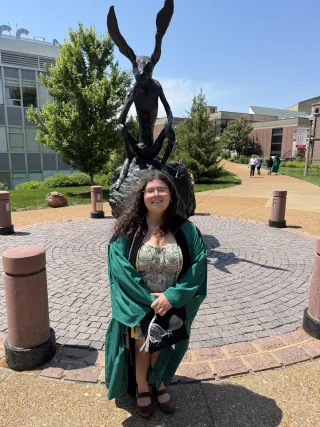
MJ Jones shares her thoughts on the Living History Scholars Initiative:
The Living History Scholars Initiative and the process of writing a history thesis were both incredible experiences, and I would encourage anyone even remotely interested in pursuing a thesis to apply for the grant! I feel more confident in my skills as a researcher and writer because of the work I have done. I am immensely proud of the scholarship I have produced. The mentorship I received from my primary advisor Dr. Wakeley-Smith and from Dr. Watt was invaluable and has changed how I approach writing. It is no exaggeration to say that I would not have gotten into law school without writing a thesis—my interview went long because my interviewer had questions about the Chicago World’s Fair. Yet, even if that were not the case, and I had not won the Mendel Sato Award or gotten into law school, I would still recommend everyone write a thesis. It was, by far, the best thing I did at WashU.
Living History Scholars
Project Proposals for the Living History Scholars Initiative should be sent in the form of a Word document attached to an email (please note that the due date is Friday, November 13, 2026) by 5:00 p.m. Central Time with subject line "Living History Scholars '26 Project Proposal." Living History Scholars projects for spring term '27 will be announced early in December. If you have any questions as you are thinking through or putting together a Living History Scholars proposal, feel free to contact cjohns@wustl.edu. She is available in the weeks ahead (before the November 13 deadline) to help you think through/draft a proposal.
Mendel Sato Research Award
Learn more about the award and take a look at past projects: