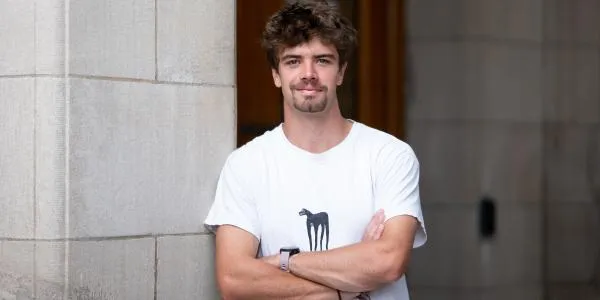
Francisco Perez, an undergraduate in history, organized a lecture at the Missouri Historical Society
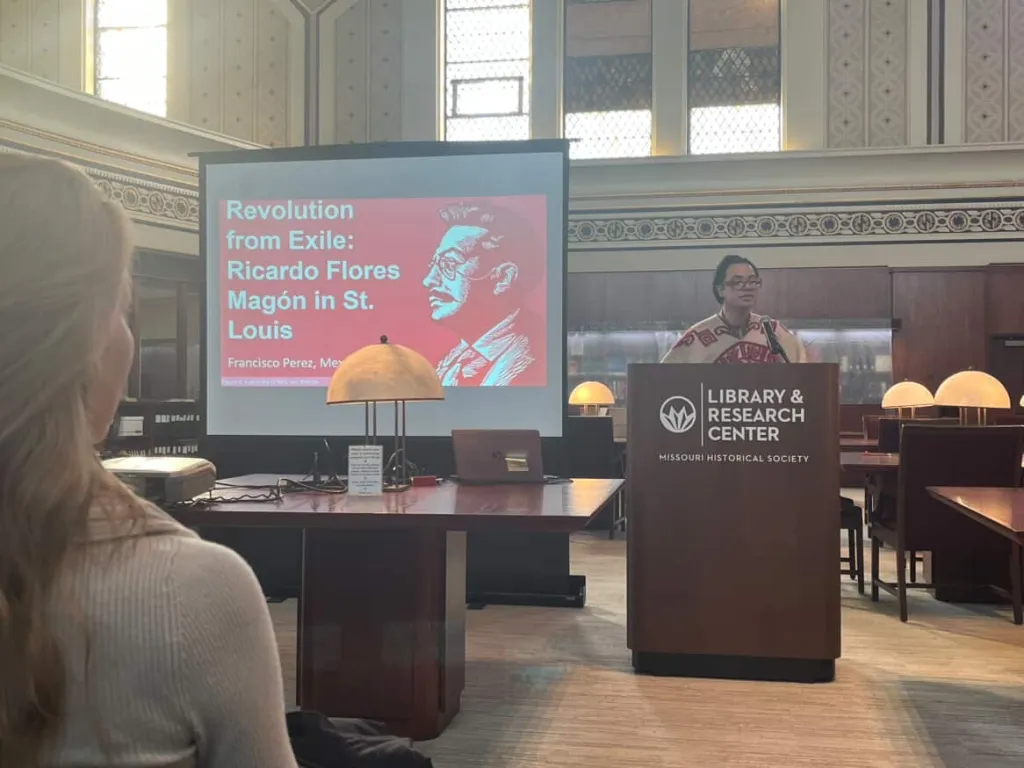
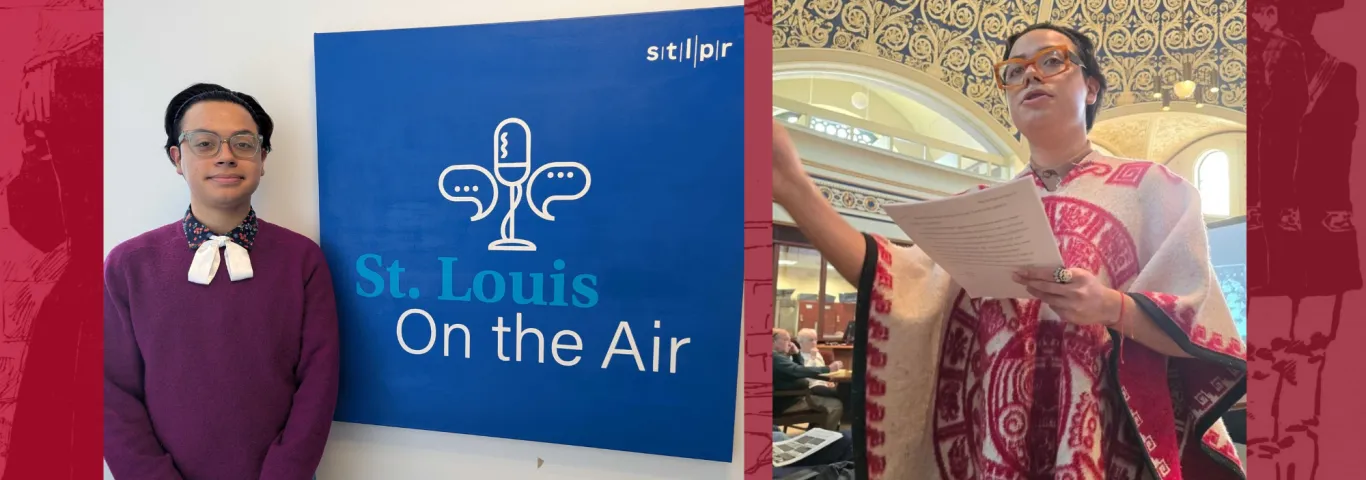
In 1905, Mexican Journalist Ricardo Flores Magón escaped the Porfiriato dictatorship and settled in St. Louis, where he launched the newspaper Regeneración. With 20,000 readers throughout Mexico and the U.S., the leftist publication raised awareness of growing weather inequality, labor exploration, and political corruption in both countries. Fransciso Perez, an undergraduate in history, was featured in an STL on the Air episode covering this topic. Francisco shares how Flores Magón connected the struggles of the American working class with that of the Mexican working class, how St. Louis' labor movement shaped Flores Magón's worldview, and why, more than a century later, the activist's politics still resonate (STL Public Radio/STLOnAir).
We reached out to Perez to learn more about how this opportunity came about; Perez collaborated with several WashU alums to put this lecture together.
How Franscisco acquired the opportunity for the talk -
The opportunity to join MexStl.org, an organization founded by WashU students to uncover the history of Mexicans in the city, came out of the blue in one of my history courses. I just so happened to be classmates with the organization’s founders, Jade Pita del Prado (Class of 2025) and Jonah Zachs (Class of 2025), when they pitched me the organization’s community-driven mission to explore the region’s history; I eagerly accepted.
Preparing for the Missouri Historical Society Library Speaker Series was not a one-man show. Jason Stratman, host and organizer of the series itself, was generous enough to share the library's time and space with our organization. Nicole Ambar de Santos, another MexStl.org colleague (Class of 2026), ardently promoted the event across WashU organizations and departments. Jonah Zachs was kind enough to connect me with St. Louis Public Radio to share the history of St. Louis and the Mexican Revolution, along with some media training! The hospitality of the team behind St. Louis on the Air, from host Elaine Cha to producer Emily Woodbury, and all the staff keeping the show running. And Jade Pita herself, who co-researched and edited my speech for the speaker event. These members of MexStl.org were not history majors or minors, but historians at heart.
The talk -
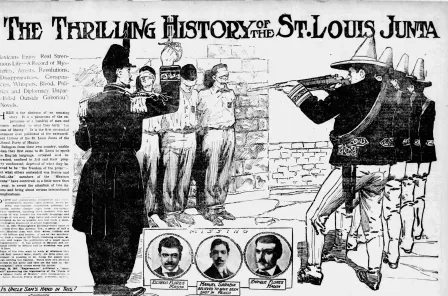
Jade and I wanted the talk to be less of a lecture and more of a speech, a story, full of the emotions that ran high during the Mexican Revolution. Ricardo Flores Magón was an outspoken journalist who founded the Mexican Liberal Party in St. Louis to successfully jumpstart a revolution against Mexican dictator Porfirio Díaz, with the support of the Mexican and American working class. Magón once said to his brother that paper was to be his “greatest weapon.” Then let me tell you that history is my greatest weapon. I did my best to project emotion, voice, heart, and soul when reading excerpts from the letters St. Louisans sent to the local newspapers defending Magón and his cause, that of American labor leaders endorsing and fundraising for Magón’s cause; after all, the U.S. government persecuted him to protect a Mexican dictator favorable to American business. And, of course, performed the speeches Magón wrote in his newspaper, Regeneración (Regeneration), explaining why he chose St. Louis to carry out the ideals of Mexican democracy, justice, and labor rights that the revolution entailed. The audience cheered for Magón, I hope they felt part of their city’s history, just as my history and humanities professors—in WashU, high school, and middle school—made me feel part of their classrooms and broader St. Louis community. That event became the second-most attended event in the program’s history. People stood, people leaned on walls, sat on the floor, all to hear their city’s world history.
Inspiration for studying history -
Resistance, the way people and immigrants of color resisted tyranny in St. Louis, defines the main theme I always cover in my history courses’ final research projects...
I do not necessarily have a concentration for my history major. I take all history classes that interest me. History of madness, cookbooks, immigration, technology, medieval micro-history, and I loved them all! Most of the time, when registering for future courses, I do not even look at the course content; I just register if I find a professor intriguing or curious. That is enough for me, because I have faith in the quality of the History Department faculty.
But if I were to really define my concentration, it would be Saint Louis history. For those who know me, that raises eyebrows. I am a Chicagoan, born and raised, mighty proud and boastful about it. Truth be told, Saint Louis was why I chose WashU, and it was also why I declared my major in history. When I was a first-year, I took a course called “WashU’s Relation to Enslavement” with Dr. Iver Bernstein and Carl Craver. Despite the course’s morbid subject, I learnt stories of resistance: the freedom crossings up north, the legal battles that would culminate in the Dred Scott Case, the enslaved and formerly enslaved coming to the city for a better life. Resistance, the way people and immigrants of color resisted tyranny in St. Louis, defines the main theme I always cover in my history courses’ final research projects; all my history professors have encouraged and taught me to dig into the archive and read it in the most radical and unconventional of ways. Finding the names and personalities of Black Americans in the very bonds they were obliged to sign and pay to be “free” in the city, getting to know the activism of Jeu Hon Yee in defending the Hop Alley immigrant community through newspapers that actively mocked him—that is how I was taught to read against the archive. The literacies that the history department taught me all culminated in the Speaker Series lecture on Saint Louis’ role in the Mexican Revolution.
How Francisco has come to see St. Louis -
After that experience, for which I will be forever grateful, I have come to see St. Louis as a Latin city. It used to border New Spain; it was part of the Santa Fe Trail; the Afro-Latin tango is embedded into W.C. Handy’s St. Louis Blues; current-day Cherokee Street and, within the Carondelet neighborhood, the St. Cecilia Catholic Church and School offer a vibrant Latin immigrant community. The history of St. Louis is world history.
Learn more and listen to the podcast here: St. Louis On the Air
The Fall 2026 Undergraduate Research Symposium
The Office of Undergraduate Research is hosting the Fall 2026 Undergraduate Research Symposium on Friday, November 6, from 10 AM – 3:30 PM in Hillman Hall.
Drop by any of 7 symposium sessions from 10 AM – 3:30 PM on November 6 to pick your peers’ brains about how and why they started research and what they’ve learned and experienced. Not sure where to start? Talk with one of the Undergraduate Research's dedicated WashU Research Ambassadors!
Consult this filterable presenter list to identify participating majors from your department and their session assignments. On the day of the symposium, the online program containing project abstracts and visuals will go live on the symposium website. In the meantime, thank you for joining the collective effort to showcase the WashU undergraduate research community!