A PhD in History can lead to a wide range of careers and opportunities.
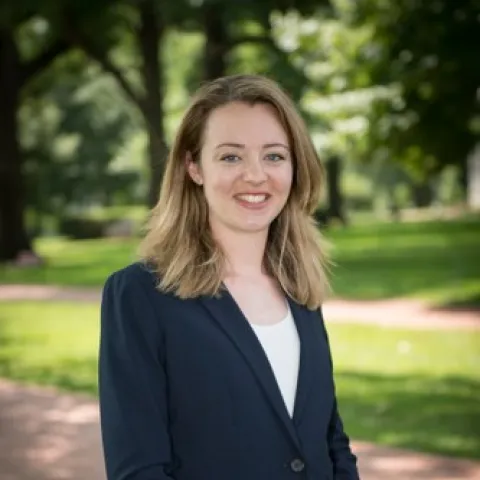
In this series, WashU History alumni reflect on their time in the program, the research that continues to inspire them, and the careers they have built since graduation. We're continuing this Q&A series with 2017 PhD Graduate, Amanda Scott. Scott is now an Associate Professor of History and Women's, Gender, and Sexuality Studies and serves as the Director of Undergraduate Studies at Penn State.
What drew you to pursue a PhD in History at WashU, and what areas of research most inspired your work here?
I came to Wash U because the funding package was unmatched by any other school: the number of years supported, the fellowship releases, the summer research money, and all the other opportunities and workshops. I also wanted to work with Daniel Bornstein who was a perfect thematic match for me: though I wanted to work on early modern Spain, and Daniel works on Renaissance Italy, he was the absolute best choice for working on women and religion.
Tell us about your current work; what questions are you trying to answer, and why do they matter to you?
I am currently writing a new history of the Romani in early modern Spain. Specifically, I am interested in the effects on women, children, and families from criminal sentencing of men to the galleys and presidios, which I argue, intentionally dismantled families and sought to break apart Romani culture. I am also interested in recovering a history that is not simply what happened to the Romani via royal decrees, exclusion and exile, and court penalties, but what their lives were like in the two centuries leading up to the Gran Redada, or the general roundup and arrest of all Romani people in 1749. I use notarial records, court trials, Inquisition records, and wills, most of which have never been tapped in any systematic way. Essentially, I am seeking to understand the politics of family separation in the seventeenth and eighteenth centuries, how ethnic minorities were criminalized, and how women and children bore the brunt of these policies. In this light, the criminalization of the Romani during the early modern period was a dress rehearsal for modern policies, and understanding what happened to this group now can help give us perspective and help us practice empathy today.
What has your professional path looked like since completing your PhD?
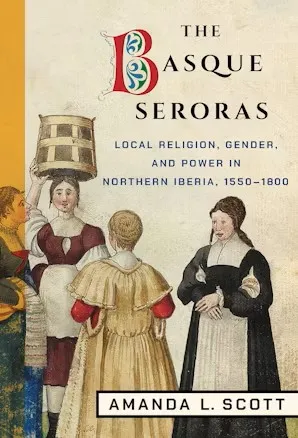
I graduated in May 2017 and started a tenure track job at the US Naval Academy. I moved to Penn State in 2019, and published my dissertation book in March 2020, The Basque Seroras: Local Religion, Gender, and Power in Northern Iberia (Cornell UP). I was tenured in 2023 and took an NEH fellowship from 2023-24 to work on my second book. This
book, entitled Banished at the Crossroads: Exile, Poverty, and Banditry in Early Modern Spain, is in press with Cornell UP and coming out in Spring 2027. I am currently the Melvin and Rosalind Jacobs Endowed Fellow in the Humanities and Associate Professor of History and Women, Gender, and Sexuality Studies and the Director of Undergraduate Studies for the History Department.
How did your time at WashU shape the way you approach research, teaching, or public engagement today?
I received the best mentoring anyone could want from Daniel Bornstein, who showed me by example how mentoring and training of each individual grad student called for a different approach, person to person. I am also grateful for seeing a range of different teaching styles, namely from Mark Pegg, Christine Johnson, and several professors who have now left Wash U. In particular, since coming to Penn State, I have been tasked almost every year with teaching the first-year grad Method and Literature of History seminar, which I model consciously on the one I took with Maggie Garb in 2010. I have experimented with different approaches to this seminar, finally settling on a final paper that is a personal historical genealogy, either lateral (of each students’ older grad siblings) or vertical (of their advisor and their academic grandparents and great grandparents). I think I am channeling what Daniel helped instill in his students through this assignment, as Daniel always taught us to read acknowledgments carefully and to pay attention to how one’s academic genealogy shapes the kinds of methods and questions we want to ask. I think my students get a lot out of this assignment: it often encourages them to make contact with the elders in their field, they learn a lot about the dissertation projects their older siblings have completed and patterns in research and advising, and finally, they get to know their advisors really well very early on. These are skills that help them immensely later in grad school.
What have been some of the biggest challenges or rewards in your career so far?
For several professional and family reasons, I have been under a lot of pressure to tenure and promote quickly, and to get a lot of publications out rapidly. This has been challenging but has helped me develop extremely good organizational skills and discipline and has also taught me a lot about the benefits of shedding perfectionism in favor of learning to be satisfied by my own work.
What advice would you share with current graduate students who are thinking about the next steps in or beyond academia?
This is hard advice and I don’t mean to be discouraging, but I would caution that the field is always changing, and we are constantly expected to do more. It is hard as a grad student to understand just how long it takes to achieve a successful grant application or get publications out. Think about what your future self would have wanted you to do now, and then do that. Look around you in your program and identify the most successful recent student and then use that person’s successes for your own personal goals—and then do more. I don’t mean this in a competitive way, but to learn what is possible and what you can do. You can learn so much from your grad siblings, and you are never going to have such a close group of academic supporters: spend time with them, go out together as a group after seminar, and be there for each other.
What advice would you give with those who are considering pursuing a PhD in History?
The field is competitive and it is hard to predict what will happen in five, six, seven, or more years, including what kind of jobs there will or won’t be. You shouldn’t pursue a PhD in history because you want to become a history professor (though this is a great path if you can find a job). Instead, you should do a history PhD because you want to accomplish something big, and because it is a personal goal of yours to spend years working on a deep research project and then writing up what is essentially an entire book. If you think you can be happy and proud of yourself for accomplishing something that big, and you are not necessarily attached to what comes next—or better yet, you have a lot of flexible and creative ideas of what you could do with a PhD and why it is generally good for society to have more people with humanities PhDs out in the world making decisions—then you should definitely go for it!
The History PhD Program at Washington University in St. Louis is celebrating its 100th anniversary in 2026!
Join us on September 19, 2026, from 9:15 a.m. to 4:30 p.m. as we celebrate a century of history, scholarship, and community.