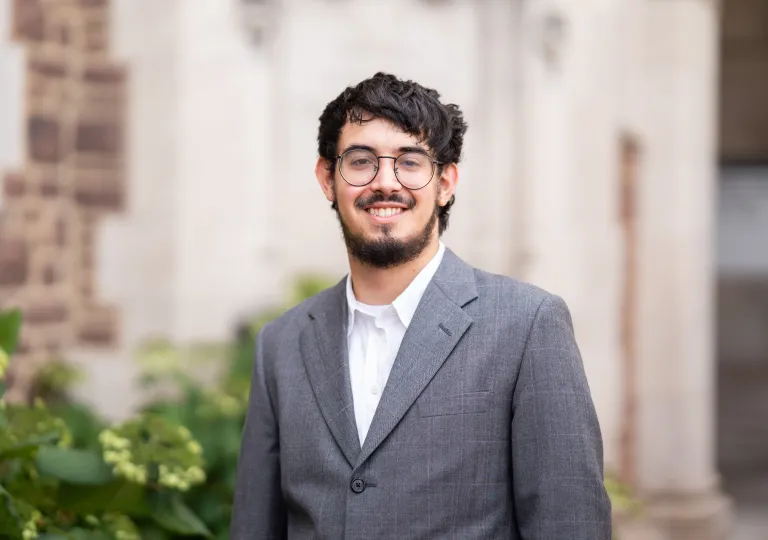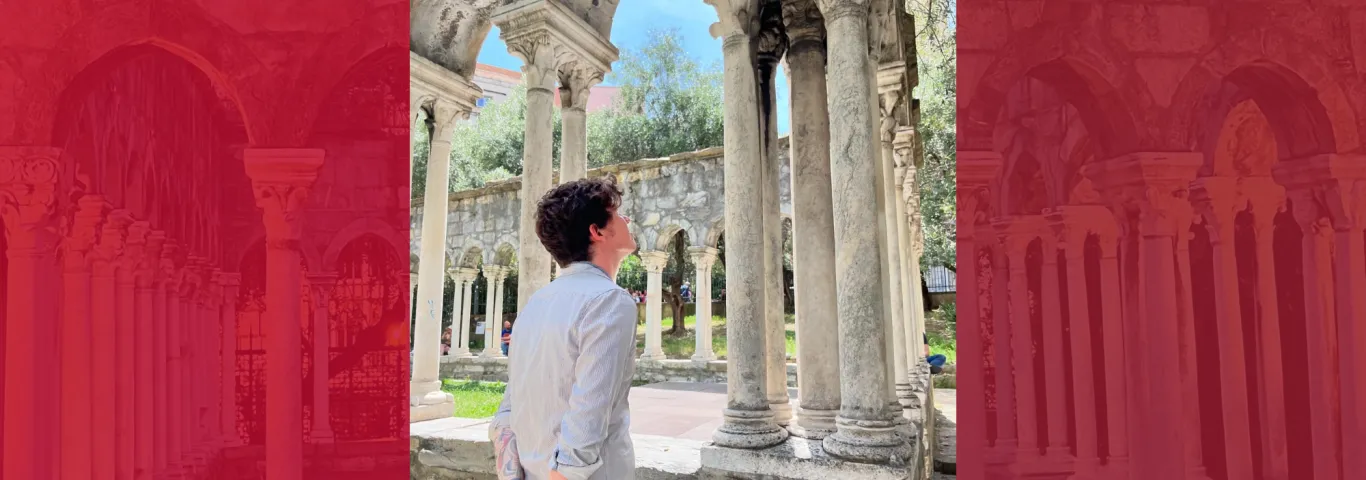
Lee Morrison received the Andy Kelly Prize for his article, “The Women of the Gate: Ecclesiastical Neighborhood Development in Late Medieval Genoa”.
The Andy Kelly Prize for Best Article in the journal Viator is awarded biannually to an essay published in the preceding two volumes of Viator and judged by the selection committee to be exceptional.
Lee Morrison, “The Women of the Gate: Ecclesiastical Neighborhood Development in Late Medieval Genoa” Viator 54, no. 2.
Through meticulous research and data analysis, Morrison develops a compelling microhistory of a community of Genoese nuns that has broad implications for the history of women’s communities.
Now Available in Free Access until May 31st 2026 on BrepolsOnline
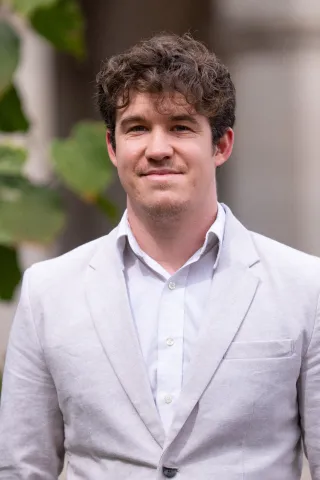
Morrison was inspired to write the article due to his interest in the daily lives of religious communities.
In general, the inspiration for the article came from my interest in the day-to-day lives of religious communities, especially those that were located in cities, and how they interacted with the surrounding lay communities. Much like the contrada Sant'Andrea, the article emerged in successive phases. I found the primary source, the cartulary of Sant'Andrea della Porta in Genoa, through my exploratory dissertation work and had previously used it in a more limited fashion for my master's thesis. At the time I was looking through it for documents relating to charity, not urbanization, but I kept pausing to read the livelli (leases) and was fascinated by the range of social and economic detail in those documents, such as the size and price of properties, occupational designations of tenants, and the various ways in which the sisters of Sant'Andrea were quite literally structuring their small patch of the city. I wrote an initial version of the article as a term paper for Professor Daniel Bornstein's "Nuns" seminar in 2022, where I focused on how the community of nuns resisted claustration and maintained their independence from larger religious institutions through the day-to-day administration of urban properties. The sisters routinely met with new and existing tenants in the portico and cloister of Sant'Andrea. Finally, I incorporated geospatial mapping (GIS) after taking a course with Professor Kyle Olson (Anthropology) in Spring 2023. He worked with me on how to best adapt these sources for GIS mapping, and the result significantly improved my argument by enabling me to visualize how the neighborhood around Sant'Andrea developed in phases, led by successive abbesses of the community.
The research behind this article:
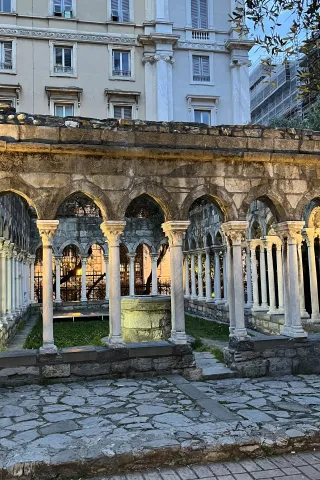
The article takes a close look at the process of urban development and neighborhood formation in a medieval city, which is my primary research focus. I have always been interested in the physical development of cities during the middle ages, especially the lands on the edges of cities where most of the growth happens. These are the areas where migrants from the countryside established themselves in the city and where the workers, who were the backbone of the urban economy, made their residences. Because land was cheap in these areas, and the buildings were less spectacular than those in the city center, peripheral neighborhoods haven't been as thoroughly studied, but they can tell us quite a bit about who was coming to the city and how they interacted with urban institutions, especially notaries and religious communities. I am also interested in applying digital humanities methodologies to medieval history, including geospatial mapping and spatial prosopography. The documents that I used for this article include boundary descriptions of the front, back, and sides of each property. Piecing these descriptions together was challenging, but it presented an opportunity to map out the neighborhood of Sant'Andrea over about a century and look closely at how successive abbesses contributed to the urban environment around them.
Broadly, I study the social and economic history of Northern Italian cities. My dissertation project focuses on the social structures of residential neighborhoods on urban monastic lands in medieval Genoa, between 1150-1350. My work examines the relationships between ecclesiastical institutions and their tenants, arguing that both groups were influential contributors to urbanization during the thirteenth and fourteenth centuries. I primarily use documents produced by notaries, but my work also draws upon institutional archives, episcopal legislation, and vernacular sources to provide a broad perspective on urban life during the period.
How he learned of this opportunity:
When I was preparing the piece for submission, I researched several journals to try to find the best fit. With its focus on interdisciplinary research (and very magnanimous word limit!), Viator seemed to be the ideal journal for this piece, and they generously print their issues in color, which allowed me to make the most of the neighborhood maps that I had developed. The editors, Matthew and Allison, have been very supportive through the publishing process and beyond. They have stayed in contact with me since the initial publication, including notifying me that my article was eligible for the Andy Kelly prize this year. I am very grateful to them for the support that they have shown me and my work.
Advice to others who are preparing work for publication:
While I was preparing the manuscript for initial submission and trying to decide when it was ready, I tried to remind myself that it should be polished, but not perfect. For graduate students in particular, you shouldn't feel that you have to wait until the end of the graduate program to try and submit something to a journal. It is extremely valuable to gain early experience with the submission procedures, peer review, and corresponding with editors. Regardless of the outcome of the submission, the feedback that you receive from reviewers will challenge and ultimately improve your writing.
LEARN MORE about the Andy Kelly Prize
LEARN ABOUT The History Graduate Program at Washu