
Ben Wexler, graduate student in History, recently published a paper in the journal Narahaim.
"Mimetic Violence and Sacred Performance in Charlotte Salomon’s Leben? oder Theatre?"
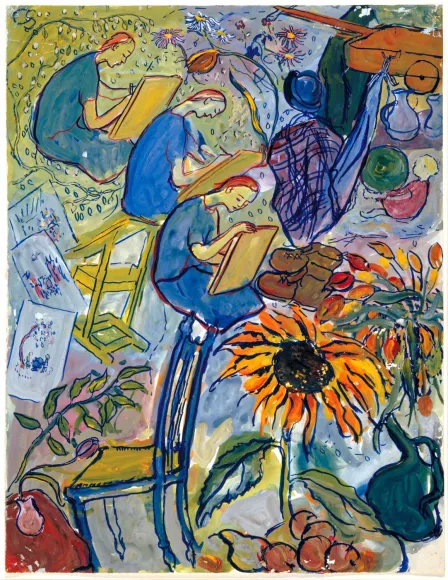
This paper began as a course paper for a seminar I took on Jews and Music (with prof. Christopher Silver at McGill University). I was drawn to Charlotte Salomon as an artist and historical figure, and, in the context of the class, as someone who made art about music without making music per se. Salomon’s foremost surviving work, Life? Or Theatre?, collects hundreds of paintings into semi-autobiographic narrative about love, art, and violence in a German-Jewish family during the Nazi rise to power.
The article largely consists of a close reading of Life? Or Theatre?. I felt that Salomon’s work could be better understood through newer approaches to modern German-Jewish life that emphasized the interdependence of German and Jewish identities, rather than the assimilation of the latter into the former (an approach here influenced notably by Sharon Gillerman and Till van Rahden). How did the Nazi rise to power and the segregation of “Jewish” from “German” transform this intercultural world? Following Salomon’s own fascination with representation and imitation, I pursued this question of German-Jewishness through anthropological approaches to mimesis and performance. I also drew on an already impressive body of secondary scholarship regarding Salomon and the Jewish Cultural League, most notably Griselda Pollock’s work on the former.
My work on Salomon guided me towards my current research on Jewish emancipation and Jewish-Christian relations in modern Europe. As I realized that these topics could not be fully explored only in the twentieth century, I moved further into the past. My research now leans more towards the history of ideas and state-formation than the art-historical approach of this paper. Today I am interested in the question of sovereignty as manifested in conflicts over Jewish legal and political status in the late eighteenth and early nineteenth centuries. But I remain motivated by many of the same themes: the fraught line of intercultural transformation and the insufficiency of “assimilation” as a framework for European-Jewish modernity.
This paper transformed profoundly thanks to notes from my supervisor Jonathan Judaken and from anonymous reviewers at Naharaim. My main takeaway from this experience has been to embrace comprehensive editing. The final draft resembles the original paper very little, and it is much improved.
The journal Narahaim was founded by the Franz Rosenzweig Minerva Research Centre at the Hebrew University of Jerusalem in 2007 and appears bi-annually. It is a peer-reviewed journal and publishes the latest research on philosophical, literary and historical aspects of German-Jewish culture. The articles appear in both German and English.