Douglas Flowe has been selected as a fellow at the National Humanities Center for AY2026-7.
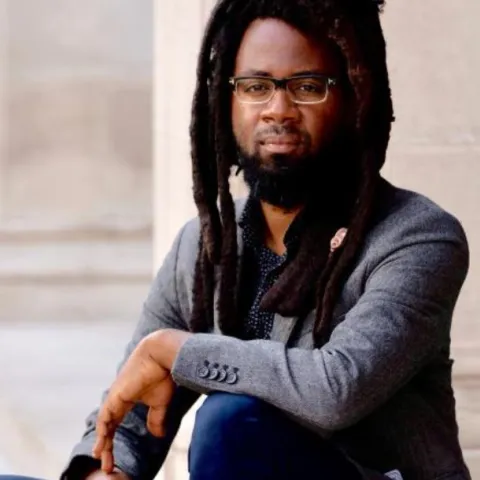
Douglas Flowe, associate professor of history at WashU, has been awarded a residential fellowship from the National Humanities Center for the 2026–2027 academic year.
Flowe’s project, American Darkness: Black Men in New York’s Jim Crow Prisons, explores the lives of Black men in early twentieth-century New York’s penal system, tracing how incarceration shaped their experiences and the broader dynamics of race and punishment. The project will be the focus of his work during his residency at the Center, where the fellowship will support a year of research and writing as he completes the manuscript.
About the Fellowship
The National Humanities Center offers residential fellowships to support advanced research in the humanities. Fellows are selected through a highly competitive, merit-based process, with only a small number chosen each year from a large international pool of applicants. Located in Research Triangle Park, North Carolina, the Center provides scholars with time, space, and resources to pursue significant projects.
Read more about Douglas Flowe's fellowship in this article with The Record: https://source.washu.edu/2026/05/flowe-named-national-humanities-center-fellow/
The National Humanities Center (NHC) is pleased to announce the appointment of 29 Fellows for the 2026–27 academic year. These leading scholars will come to the Center from universities and colleges in 15 US states and the District of Columbia, as well as Ghana. Chosen from 453 applicants, they represent humanistic scholarship in African studies; American studies; anthropology; archaeology and history; classics; environmental studies; ethnomusicology; food studies; history; history of art and architecture; English and indigenous studies; languages and literatures; Middle East studies; music history and musicology; and philosophy. Each Fellow will work on an individual research project and will have the opportunity to share ideas in seminars, lectures, and conferences at the Center.
Apply for 2027–28
The Center will begin accepting applications for the 2027–28 academic year on July 1, 2026 with a deadline of October 1, 2026. Details about NHC fellowships, including application instructions, are available here.
These newly appointed Fellows will constitute the forty-ninth class of resident scholars to be admitted since the Center opened in 1978. “We are so excited to support the important work of this upcoming class of scholars,” said Martha Kelly, vice president for scholarly programs. “Their projects showcase some of the best work being done in the humanities and highlight the value humanistic scholarship brings to our daily lives. Their diverse interests will also help foster the vibrant intellectual community for which the National Humanities Center is known.”
The National Humanities Center will award over $1,600,000 in fellowship grants to enable the selected scholars to take leave from their normal academic duties and pursue research at the Center. This funding is provided from the Center’s endowment and by grants and awards from the Henry Luce Foundation, as well as contributions from alumni and friends of the Center.
NHC Fellows and Their Projects, 2026–27
Project disciplines and home institutions are parenthetically noted for each Fellow.
- Mike Amezcua (History; Georgetown University) Dinero: A History of Latino Capitalism in America
- Darlene L. Brooks Hedstrom (Archaeology and History; Brandeis University) Monks as Makers: A Material History of Monasticism
- Mónica Díaz (History; University of Kentucky) Indigenous Spaces: Education and Religion in Colonial Mexico
- Kevin Escudero (American Studies; Brown University) Imperial Unsettling: Indigenous and Immigrant Activism toward Collective Liberation
- Douglas Flowe (History; Washington University in St. Louis) American Darkness: Black Men in New York’s Jim Crow Prisons
- Dave Fossum (Music History and Musicology; Arizona State University) Remembered Innovation: A History of Creativity in Turkmen Music
- Alexis Pauline Gumbs (Languages and Literatures; Independent Scholar) Love is Lifeforce: June Jordan and Fannie Lou Hamer Solve the Energy Crisis
- Olabode Ibironke (African Studies; Rutgers, The State University of New Jersey) The Republic of Laughter: Television and the Affective Archives of Postcolonial Nigeria
- Peter R. Kalb (History of Art and Architecture; Brandeis University) Apollo’s Gift: An Art History of the Moon Landing
- Danielle L. Kellogg (Classics; University of Cincinnati) Mobility, Citizenship, and the Athenian Democracy
- Emil’ Keme (English and Indigenous Studies; Emory University) Abiayala: A Trans-Hemispheric Indigenous Manifesto
- Kate L. Lindsey (Linguistics; Boston University) A Speaker-Focused Grammar of Ende, A Language of Papua New Guinea
- S. M. Love (Philosophy; Georgia State University) Freedom from the Market: A Kantian Account of Socioeconomic Rights
- Allie Martin (Ethnomusicology; Dartmouth College) Sampling for Black Life
- Sarah Milov (History; University of Virginia) Damned Women: Sex and Sterilization at an American Factory
- Eric Debrah Otchere (Music History and Musicology; University of Cape Coast) From Nets to Notes: A Multi-Modal Analysis of Knowledge Translation in Ghanaian Artisanal Fishing Communities
- Vanessa Pérez-Rosario (American Studies; Queens College and the Graduate Center, City University of New York) Las Girlfriends: A Cultural History of Latina Feminist Writing from 1980 to 1994
- Bianca Premo (History; Florida International University) Peru’s Youngest Mother in the World and the Ethics of History
- Isaias Rojas-Perez (Anthropology; Rutgers, The State University of New Jersey) After “Never Again”: The Dead, Forensic Exhumations, and Percolations of Justice in Postwar Andean Peru
- Susanna L. Sacks (Languages and Literatures; Howard University) A World of Debt: African Literature in the Wake of Structural Adjustment
- Nazera Sadiq Wright (Early African American Literature; University of Kentucky) Early African American Women Writers and their Libraries
- Kathryn Vomero Santos (Languages and Literatures; Trinity University) Mischiefs Manifold: A Cultural History of Sycorax
- Orin Starn (Anthropology; Duke University) Love Yourz: Battling Amazon in Too Late America
- Rebecca L. Stein (Anthropology; Duke University) How to Unsee Gaza: Israeli Visual Politics in a Time of Genocide
- Despina Stratigakos (History and Environmental Studies; University at Buffalo) Ghost Gardens
- Kyla Wazana Tompkins (Nineteenth-Century American Studies and Food Studies; University at Buffalo) Acquired Tastes
- James Van Cleve (Philosophy; University of Southern California) Roderick Chisholm and Philosophy in America, 1950–2000
- Joshua M. White (History; University of Virginia) Of Free Origin: Slavery and Freedom Suits in the Ottoman Empire, 1550–1840
- Nadia Yaqub (Middle East Studies; University of North Carolina at Chapel Hill) Alternative Cinema in the Arab World
About the National Humanities Center
Contact
Don Solomon
Vice President for Communications and Marketing
(919) 406-0120